Acreage buyer's guide · Ada and Canyon counties and Emmett
Idaho Water Rights: What Acreage Buyers Need to Know
Idaho water rights are the state's permission to use water. Near Boise, a water right usually passes to the buyer with the land. As of November 2026, the buyer files a notice with the Idaho Department of Water Resources (IDWR) within 120 days and pays $25 per right.
This guide covers how to look up the water rights on a property near Boise, what to file after you buy, how a right gets lost, and how much a home well can use without one.
Last updated November 19, 2026
Questions in this guide
Do water rights come with the land when you buy property in Idaho?
Yes, Idaho water rights pass to the buyer with the land unless the deed reserves them. Idaho Code 55-617 sets that rule, and it also covers irrigation district and canal company water.
The longer answer
Idaho treats a water right as part of the land it waters. The statute calls it an "appurtenance" of that land (Idaho Code 42-101). When the land sells, its water rights go with it.
- Recorded water rights pass to the buyer if the seller owns them and the deed doesn't reserve them (55-617(1)).
- Irrigation district water passes too, along with the duty to pay the district's assessment (55-617(2)).
- Canal or ditch company water passes as shown by stock or other proof of the right to receive water (55-617(5)).
- Water rights used on other land don't pass (55-617(6)).
IDWR lists three things that point to a valid right coming with a property: water was used there before, the seller didn't reserve the right in the deed, and the right hasn't gone five or more years unused.
What to ask before you offer: the water right numbers, a copy of the deed and the prior deeds, and when water was last used on the land.
How do I find out if a property has water rights in Idaho?
IDWR's free Water Right Locator map shows recorded water rights by location. Find the property on the map, click it, and open each right to see its owner, priority date and use.
The longer answer
- Open IDWR's Water Right Locator map. IDWR's "Map-Based Water Rights Search" and "Irrigation Water Rights Finder" buttons both open this same map.
- Search the address or zoom to the parcel. The map shows where water is diverted and the land it's used on.
- Click a mapped right to see its number, owner, priority date and use.
- For the full record and its documents, search the number in IDWR's Water Rights and Adjudication Search.
- Compare the owner name on the record with the seller on the title report.
Idaho water right numbers have up to three parts: a basin number, a sequence number and sometimes a suffix. If the seller believes there are rights but doesn't know the numbers, IDWR will help identify them. Its statewide line is 1-800-451-4129.
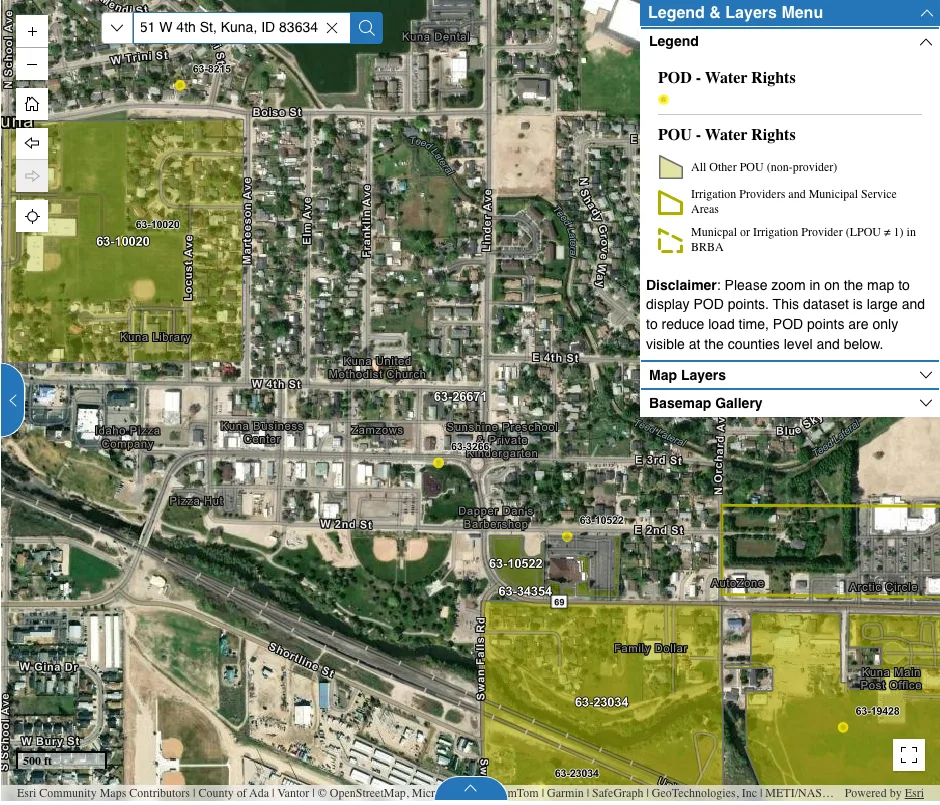
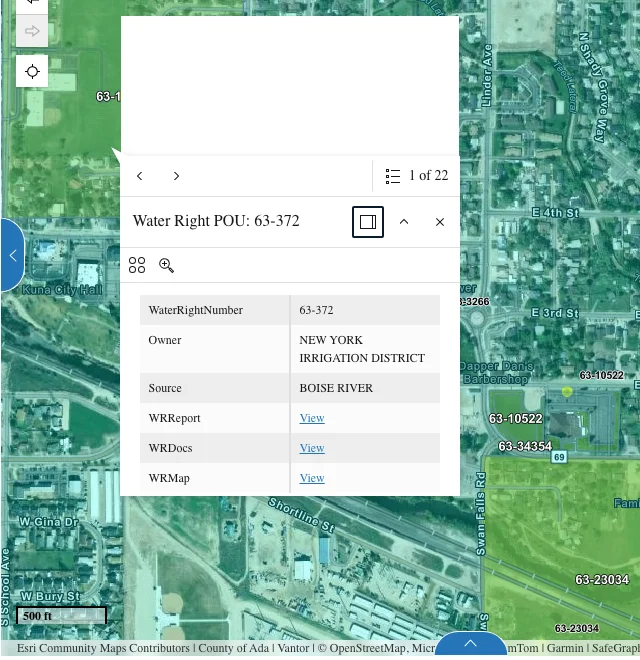
Here is what that looks like in practice. When we searched Kuna City Hall's address on November 19, 2026, IDWR's map showed 22 water rights on that one spot. The first, 63-372, is owned by New York Irrigation District, with the Boise River as its source. That is why a house in town can have irrigation water without a water right in the owner's name.
Most homes near Boise get irrigation from an irrigation district, not their own water right. In that case the district holds the right, and the property won't show up under the owner's name. The irrigation districts near Boise guide shows how to find which district serves a property.
What do I file after buying land with a water right?
Idaho buyers file a Notice of Change in Water Right Ownership with IDWR within 120 days of closing. The fee is $25 per right, or $100 per right when the right is split.
The longer answer
| What | Detail |
|---|---|
| Form | Notice of Change in Water Right Ownership (IDWR Form 42-248/42-1409(6)) |
| Deadline | 120 days after the change |
| Fee | $25 per right; $100 per right when ownership is divided |
| Attach | A copy of the deed or other conveyance document |
| Law | Idaho Code 42-248 |
- Small changes count. Adding or removing a spouse, or moving title into your own LLC, is an ownership change that needs a notice.
- District water is different. If an irrigation district, canal company or city holds the water right, don't use this form. Ask that organization what it needs.
- IDWR's record isn't a title. Ownership disputes go to a water rights adjudication or a quiet title action (42-248(8)).
Can you lose a water right in Idaho?
Yes, an Idaho water right can be forfeited after five straight years without use. Whoever claims forfeiture has to prove it by clear and convincing evidence.
The longer answer
Idaho Code 42-222 says a right is "lost and forfeited" when the water isn't put to its use for five years in a row. A forfeited right goes back to the state.
- Extension: IDWR can grant one extension of up to five more years, but the owner has to apply before the five years run out.
- District water: a right held by an irrigation district isn't forfeited because one landowner didn't use water, unless the district controlled that non-use (42-223(7)).
- Out of the owner's control: non-use caused by circumstances the owner couldn't control doesn't count (42-223(6)).
- Use resumed in time: if use starts again after five years but before anyone else claims the water, the right survives (42-223(12)).
On land that has sat idle, ask the seller when water was last used and for what.
Can water rights be sold separately from the land in Idaho?
Yes, Idaho water rights can move to other land, but only through an IDWR transfer that doesn't injure other users. A seller can also keep a right by reserving it in the deed.
The longer answer
Idaho Code 42-108 lets an owner stop using water on one parcel and move the right to other land "if the water rights of others are not injured." IDWR calls this a transfer: a permanent or long-term change to where the water is diverted, where it's used, when, or for what.
Water delivered by an irrigation district or canal company needs that organization's consent before anything changes (42-108). Some districts say no outright. Black Canyon Irrigation District's FAQ asks whether water rights can move to land outside the district and answers "NO."
For a buyer, the risk is a right that was moved off the land or reserved in an earlier deed. The deed chain and IDWR's record together show what's left.
How much water can a home well use without a water right in Idaho?
An Idaho home well can use 13,000 gallons a day without a water right, including half an acre of watering. IDWR calls this the domestic exemption (Idaho Code 42-111).
The longer answer
| Test in 42-111 | Limit |
|---|---|
| Home, livestock and related uses, including irrigation | 13,000 gal/day, irrigation up to 1/2 acre |
| Any other purpose | 2.8 acre-feet/year total |
Watering more than half an acre from a well generally needs a water right, unless the property's total use fits under the separate 2.8 acre-feet-per-year limit. Confirm with IDWR before relying on that.
Subdivisions have extra limits. In a subdivision of five or more lots, the exemption is limited to in-home use when the subdivision sits in a moratorium area or groundwater management area and its application was filed on or after July 1, 2025, or when lots share a well. A lot with its own well outside those areas keeps the full exemption, half an acre of irrigation included. Lots of 5 acres or more kept in agriculture don't count as a subdivision.
The current rules took effect in two steps: Senate Bill 1083 on July 1, 2025, and Senate Bill 1222 on February 17, 2026. A domestic well still needs a drilling permit; the Idaho domestic well rules guide covers permits, testing and shared wells.
How does Idaho decide who gets water first?
Idaho gives water to the oldest rights first, a rule called prior appropriation (Idaho Code 42-106). Owning land on a river gives no right to take water from it.
The longer answer
Idaho Code 42-106 says it in six words: "the first in time is first in right." In a short water year, the oldest (senior) rights are filled first and the newest (junior) rights are cut first. That makes a right's priority date one of the most important lines on its record.
"A water right is authorization to use water in a prescribed manner, not to own the water itself. Without diversion and beneficial use, there is no water right."
River frontage doesn't change that. IDWR says Idaho law "does not recognize a 'riparian right' to divert and use water." A home on the Boise or Payette River needs a water right like anyone else to pump from it.
Can Sweet Group Realty check the water rights on a property for me?
Yes, text Rick Gray the address to get its water rights, irrigation district and well log from the public records. Sweet Group Realty's acreage team works Ada and Canyon counties and Emmett.
- Water rights on the parcel, with owner and priority date, from IDWR
- Which irrigation district or canal company serves it
- The well log, if the property has a well
Sweet Group Realty, Meridian, Idaho
The short version
- Do water rights come with the land when you buy property in Idaho?
- Yes, Idaho water rights pass to the buyer with the land unless the deed reserves them. Idaho Code 55-617 sets that rule, and it also covers irrigation district and canal company water.
- How do I find out if a property has water rights in Idaho?
- IDWR's free Water Right Locator map shows recorded water rights by location. Find the property on the map, click it, and open each right to see its owner, priority date and use.
- What do I file after buying land with a water right?
- Idaho buyers file a Notice of Change in Water Right Ownership with IDWR within 120 days of closing. The fee is $25 per right, or $100 per right when the right is split.
- Can you lose a water right in Idaho?
- Yes, an Idaho water right can be forfeited after five straight years without use. Whoever claims forfeiture has to prove it by clear and convincing evidence.
- Can water rights be sold separately from the land in Idaho?
- Yes, Idaho water rights can move to other land, but only through an IDWR transfer that doesn't injure other users. A seller can also keep a right by reserving it in the deed.
- How much water can a home well use without a water right in Idaho?
- An Idaho home well can use 13,000 gallons a day without a water right, including half an acre of watering. IDWR calls this the domestic exemption (Idaho Code 42-111).
- How does Idaho decide who gets water first?
- Idaho gives water to the oldest rights first, a rule called prior appropriation (Idaho Code 42-106). Owning land on a river gives no right to take water from it.
Sources
- Idaho Department of Water Resources, Water Rights Research, read November 19, 2026
- Idaho Department of Water Resources, Frequently Asked Questions, read November 19, 2026
- Idaho Code 55-617, water rights pass with property, read November 19, 2026
- Idaho Code 42-101, water rights as appurtenances, read November 19, 2026
- Idaho Code 42-248, notice of change in ownership, read November 19, 2026
- IDWR, Notice of Change in Water Right Ownership form and instructions, read November 19, 2026
- Idaho Code 42-222 and 42-223, forfeiture and exceptions, read November 19, 2026
- Idaho Code 42-108, moving a water right, read November 19, 2026
- IDWR, Water Right Transfers, read November 19, 2026
- Black Canyon Irrigation District, FAQ, read November 19, 2026
- Idaho Code 42-111, domestic purposes, read November 19, 2026
- IDWR, Domestic Exemption and Domestic Exemption Decision Table, read November 19, 2026
- Idaho Legislature, Senate Bill 1222 (2026) and Senate Bill 1083 (2025), read November 19, 2026
- Idaho Code 42-106, priority of appropriation, read November 19, 2026
- IDWR, Water Right Locator and Water Rights and Adjudication Search, read November 19, 2026
Acres in Idaho · Acreage, land and horse property around Boise
Looking at acreage near Boise?
Text Rick what you're after: the area, how many acres, and whether you need water for animals or pasture.
Or get the acreage checklist first.